Showing posts with label dollar. Show all posts

Saturday, October 6, 2018

Indian rupee tanks against the dollar on monetary policy outlook

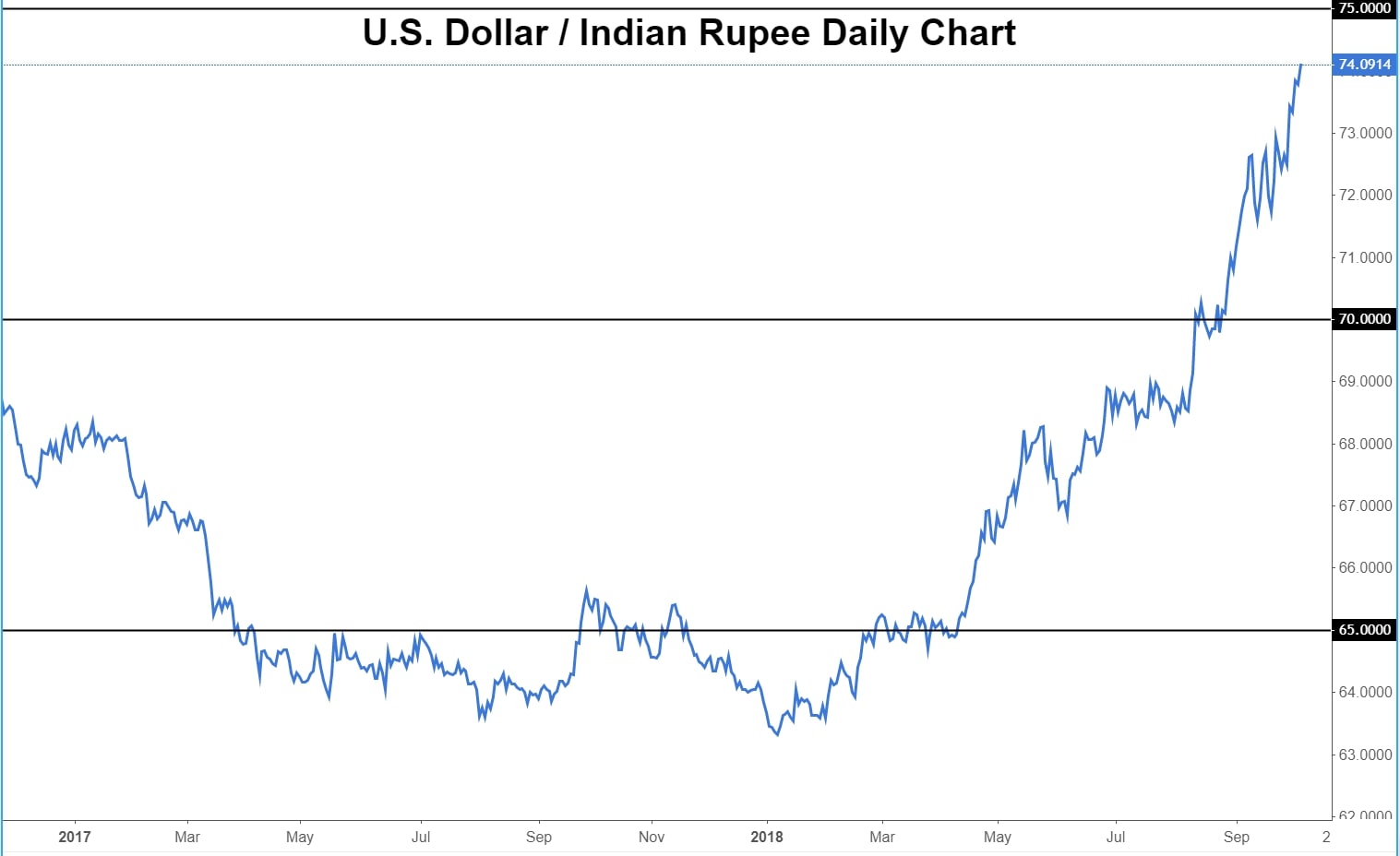
The Indian rupee hit another all-time low against the U.S. dollar on Friday, trading at slightly more than 74 rupees to the dollar. The chart below shows the USD/INR currency pair's price action over the last two years, which displays the U.S. dollar's spectacular strength against the Indian rupee, or conversely, the rupee's extreme weakness against the greenback. The Indian currency's precipitous decline started to accelerate at the beginning of this year, when the exchange rate was only around 63 rupees to the dollar. While many major currencies have been weak against a surging U.S. dollar this year, the rupee's weakness has been exceptional.

Image

Helping to fuel the latest fall for the rupee was a surprise move by the RBI, which had been widely expected to raise the benchmark interest rate on Friday. Instead, the central bank surprised to the dovish side by opting to keep rates unchanged, which led Indian financial markets, including equities and the rupee, to plunge further. The RBI's lack of action to defend its currency and fend off rising inflation was a shock that the rupee did not need, after already having lost nearly 15% of its value, year to date. The rupee's bleeding will almost certainly slow at some point, but if central bank inaction continues to rule the day, India's currency could have significantly further to fall.

By Caleb Silver, Editor in Chief (The Market Sum, Investopedia.com)

Friday, November 25, 2016

5 Reasons why FIIs may continue to sell Indian equities

The Indian stock market topped out in early Sept '16, and was going through what looked like a routine bull market correction when the bottom seemed to fall out on Nov 9 '16.

A 'double whammy' of Modi's announcement of demonetisation of Rs 500 and Rs 1000 bank notes and Trump's unexpected victory in the US Presidential elections created major panic in the market.

Those were triggers for increased selling by FIIs. Here are 5 reasons why they may continue to sell Indian equities for some more time:

1. FIIs were net sellers of Indian equity worth Rs 57.7 Billion during Oct '16 as Nifty's TTM P/E was in a range between 22.98 and 23.80 - well above its average valuation.

During Nov '16, Nifty's TTM P/E range has been slightly lower so far - between 21.19 and 23.31 - but still well above its average valuation.

2. US bond yields have moved up above 2.3%, and are expected to move up further to 2.6% or so. Why? Because of rising inflation expectations on prospects of Trump's pro-growth policies.

FIIs prefer the safety of US bonds to riskier emerging market equities.

3. US Fed is likely to increase interest rates at its policy meeting in Dec '16. At least two more interest rate increases are expected during 2017. 

Since rising interest rates usually lead to lower bond prices, yields will get a further boost which can cause more FII outflows. 

4. China's economy is slowing down, which has triggered a slump in commodity prices because China is one of the biggest buyers of commodities. Since commodity prices and the US Dollar trend in opposite directions, the Dollar has been strengthening.

A strong Dollar usually leads to selling in all emerging markets. Currencies of Indonesia, Phillipines, Mexico, South Africa, Turkey have depreciated much more than the Indian Rupee.

5. As per nominal interest rate parity theory, lower interest rates lead to a stronger currency and higher interest rates lead to a weaker currency. This is a major reason why the Indian Rupee has been depreciating against the US Dollar for quite some time.

The recent FII selling in the Indian stock market has further depreciated the Rupee against the Dollar.

In a recent interview on a business TV channel, the global equity strategist of Citi Group said unequivocally: FIIs look at three things - US Dollar, US Treasury yield and China.

Rising US Dollar and rising US Treasury yields means selling in emerging market equities (and vice versa - i.e. falling Dollar and falling yields trigger buying in emerging market equities). 

A likely Trump policy against outsourcing of US manufacturing will further affect economic growth in export-oriented nations like China, Taiwan, South Korea, Malaysia.

A self-contained economy like India will be less affected by such a policy. So far, Trump has mentioned about restricting H1B and L1 visas but nothing against services outsourcing.

Demonetisation of bank notes has led to shorter-term ETF money outflows. Longer-term long-only funds may wait for Q3 and Q4 results of India Inc. before taking a call.

If the short-term damage to India's GDP growth is not 2% (as Dr Manmohan Singh mentioned in the Rajya Sabha) but 0.5% (as Mark Mobius of Templeton said in a TV interview), Indian economy should recover over the next 6 months.

Wednesday, March 25, 2015

The likely effects of a US interest rate hike on global markets – a guest post

The US economy has been on a revival path for quite some time. The Quantitative Easing programme to stimulate a sluggish economy was gradually tapered off last year. With inflation showing signs of inching up, the stage is getting set for a possible interest rate hike by the US Fed.

Why should that be of any interest to Indian investors? Because the global economy has become a lot more interconnected. A rate hike in the US, coupled with a strong Dollar, may be a signal for FIIs to withdraw money from emerging markets (including India).

In this month’s guest post, Nishit discusses the current economic scenario in the US, and the possible effects of an interest rate hike on world markets.

--------------------------------------------------------------------------------------------------------------------------------------------

World markets were on tenterhooks – awaiting the US Fed announcement of a possible interest rate hike. Why are markets so obsessed with the US Fed decision to hike rates and how does it affect world markets?

The US Fed’s answer to the 2008 economic crisis was throwing cash to plug the gaps. They printed money and called it ‘Quantitative Easing’. Large amounts of money were made available at very low interest rates. This money found its way into many emerging markets, like India, and boosted their stock markets.

The idea was simple: borrow in the US at almost zero interest rates, invest in stock markets worldwide and mint profits. Since the rate of interest was almost zero, the currency risks were taken care of.

Quantitative Easing seemed to have worked and the US economy in the past 2 years has shown signs of recovery and growth. It is no more in recession, jobs are being added and the crutches of stimulus are no longer needed.

The US Fed had to account for this surplus printing of money and as a first step they tapered off the Quantitative Easing programme.

The next step is to hike up the interest rates as easy money can lead to inflation and creation of bubbles. Low interest rates helped to provide stimulus to the economy. Now, when the economy is up and running, the rates have to go up gradually for two simple reasons.

First is to prevent the formation of economic bubbles, and second is to provide room and buffer for providing another stimulus if the economy goes into recession again. After all, one can cut rates only up to zero.

In an isolated scenario this is fine. But in the case of the US - since it is the global leader - this extra money has been invested into various asset classes across the world. If the Fed starts hiking rates, then this money may be withdrawn from the various asset classes and will flow back to the US. The US Dollar has already started strengthening in anticipation of this.

Such a situation can lead to recession in other parts of the globe. Since the global economy is interconnected and the US companies also get a major part of their income from places other than the US, the Fed needs to tread cautiously.

To counteract the likely US withdrawal of stimulus, we have the Japanese stimulus and now the European Central Bank stimulus.

This is one of the anticipated reasons our markets are falling. One needs to keep an eye on how this plays out.

--------------------------------------------------------------------------------------------------------------------------------------------

(Nishit Vadhavkar is a Quality Manager working at an IT MNC. Deciphering economics, equity markets and piercing the jargon to make it understandable to all is his passion. "We work hard for our money, our money should work even harder for us" is his motto.

Nishit blogs at Money Manthan. You can reach him at nish.stockid@gmail.com)

Thursday, December 26, 2013

Has gold lost its lustre? – a guest post

We Indians tend to be conservative as far as investments are concerned. Why is that? Perhaps because several generations of Indians have faced hardship and deprivation due to exploitation by our ‘rulers’ – both overseas and Indian. Lack of education and infrastructure have contributed to the tendency to ‘hoard’ rather than ‘invest’.

For generations, two of the avenues for investing our little savings have been in land and gold ornaments. This is true even today in the hinterland – where infrastructure and banking services remain primitive or non-existent.

In larger towns and cities, infrastructure and services have improved to the extent that other avenues of investment – like post office and bank fixed deposits, mutual funds and equity are readily available. But our fascination for investing in real estate and gold has not dimmed.

In this month’s guest post, Nishit suggests that it may be time to reduce investment in gold. Debt and equity investments are likely to provide better returns in the foreseeable future.

-----------------------------------------------------------------------------------------------------------------------------------------

Indians are obsessed with Gold. The most common question which I am always asked is: “Should we buy Gold now or should we wait?” The Government has increased the price of Gold in India by increasing import duty - thereby reducing Gold imports and positively impacting the Current Account Deficit.

Gold by itself has no value in terms of utility and returns. Its status as a safe haven in times of uncertainty lends value to it. Gold’s price rises when uncertainty increases in the world. Earlier, the US dollar was linked to Gold’s price, but after it was delinked and the printing presses took over, the US dollar weakened. More dollars were required to buy the same amount of Gold.

Gold’s price had seen a parabolic rise in the past few years on the basis of fears of a worldwide economic collapse led by the US. Quantitative easing, the flooding of the markets with additionally printed dollars led to Gold’s price spurting up. It finally touched a peak of US $1920 in September 2011.

Gold’s price has been on a steady decline since then and has corrected to about US $1200 from $1920 - a decline of about 37.5% from its peak value. It had risen from a low of US $264 hit in 2001-2002 to $1920. The great Gold bull run may be over for now.

clip_image002

There are various reasons for this prognosis and they are:

  1. The World economy seems to be recovering and the immediate crisis seems to over
  2. US is reducing Quantitative easing; the easy money was one of the main reasons for Gold’s price to sky rocket

When Gold’s price hit a peak of $1920, the Rupee was at 46. Now, when Gold’s price has corrected 37.5% in Dollar terms, the Rupee has depreciated about 35%. Hence, in Rupee terms - thanks also to Government duties – Gold’s price has remained almost stagnant. The future movement in Gold’s price can come due to the Rupee weakening further, leading to appreciation in Gold’s price. The Rupee has been stable for the past few months.

Conclusion:

The value of Gold investing as a portfolio choice is no longer as significant as it was say about a couple of years back. Gold should still occupy maybe 5% of your portfolio instead of the earlier 10-20%. Thanks to the weakening rupee, there is still a chance to exit Gold at a very small loss or profit. Better options can be seen in debt or equity currently.

-----------------------------------------------------------------------------------------------------------------------------------------

(Nishit Vadhavkar is a Quality Manager working at an IT MNC. Deciphering economics, equity markets and piercing the jargon to make it understandable to all is his passion. "We work hard for our money, our money should work even harder for us" is his motto.

Nishit blogs at Money Manthan.)

Related Post

Gold and Silver charts: an update

Wednesday, December 12, 2012

Is this a good time to invest in gold? – a guest post

After a decent rally from the low touched in Jun ‘12, Sensex seems to be stuck in a range – neither moving up much, nor falling down. Retail participation has been low. Those who missed the rally may be waiting for a deep correction to get in. Others are probably waiting to jump in once the index hits 20000.

In this month’s guest post, Nishit argues in favour of gold as an investment avenue because the domestic and global economy is in doldrums.

----------------------------------------------------------------------------------------------------------------------------------------

Gold in Rupee terms has given just about 5-6% return in the past year. Now is a good time to look at the future prospects of Gold as an investment.

The Gold we buy in India is dependent mainly on two factors: the price of Gold in US Dollars, and the exchange rate of Indian Rupee vs. US Dollar. It is a big myth that price of Gold goes up during the Indian wedding season. Even though India is a large consumer of gold, there are other global factors driving the price of Gold.

What has been happening in 2012 is that the price of Gold in US$ and Indian Rupee have been going in opposite directions. When Rupee weakened to the 56-58 range, the price of Gold fell in Dollar terms. Also, when price of Gold rose in US$, the Rupee also strengthened.

Fundamentally, Gold is treated as a safe haven. Whenever there is a global crisis or if economies go bankrupt, the attraction of Gold goes up. 2012 was a relatively stable year and hence the price of Gold is stuck in a range between US$ 1550-1800 per ounce.

The US fiscal cliff and Eurozone sovereign defaults - if and when they happen – will cause the price of Gold to rise. Another benchmark for gold is how many barrels of oil can be purchased by 1 ounce of Gold. Currently it is about 16 barrels, which is the long-term average. If oil’s price begins to rise, gold’s price will also rise.

The exchange rate of Indian Rupee is dependent on foreign inflows. Once the inflow dries up, the price of gold will start going up in Rupee terms.

So, the price of Gold for Indians is dependent on:

  1. Rupee (watch the FII inflows)
  2. Price in US$ (watch related commodities like crude oil, and foreign economies)
  3. Performance of Dow Jones and other foreign indices

Also, just to slip in a bit of technicals, US$ 1800 has been a resistance level for more than a year and hence, expect a rally when gold’s price closes above 1800 for 3-4 days.

For the price of Gold to rise in the current scenario, the global economy has to either weaken or boom dramatically for speculation to take place. A boom seems unlikely and hence the most likely scenario is the Western economies slipping down into recession again.

One should be invested in Gold to the extent of 10-15% of one’s portfolio. It acts as a hedge against inflation simply because it guards against Rupee weakening. Once upon a time, when Rupee was strengthening and the exchange rate was heading towards Rs.40 to US$ 1, it did not make sense to add Gold.

If the Indian economy does as badly as in late 2011, it may be sensible to add Gold. In a nutshell, whenever any economy is doing badly, either domestic or global, it is a good time to invest in Gold. Even in 2008, Gold’s price shot up after the equity markets tanked.

----------------------------------------------------------------------------------------------------------------------------------------

(Nishit Vadhavkar is a Quality Manager working at an IT MNC. Deciphering economics, equity markets and piercing the jargon to make it understandable to all is his passion. "We work hard for our money, our money should work even harder for us" is his motto.

Nishit blogs at Money Manthan).

Thursday, November 1, 2012

Notes from the USA – a guest post

News and views coming out of Europe and USA generally paint a gloomy picture of the economies on both sides of the Atlantic. Europe is still struggling under recessionary conditions. USA has got its neck above the water, but growth has been painfully slow.

In a guest post full of interesting and revealing insights, KKP presents a ground-zero view of where the US economy is headed and how small investors can gear up for the unfolding scenarios.

----------------------------------------------------------------------------------------------------------------------------------------

Macro Level: Good, Bad and Ugly of the US Economy

The best predictor of economic times is the overall results, i.e. GDP. But underneath that layer there is a key measure, and that is manufacturing. Of course, the US GDP at 2.0% and the softness in GDP prediction for Canada says it all…….OK, let me say it: It is weak GDP numbers by all measures, and in the 70’s or 80’s or 90’s, Greenspan would have started lowering the rates to boost production.

Bottom-line is that without manufacturing an iPad, Car, Refrigerator, Engines, Parts etc. there would be no service industry. Manufacturing is key to any GDP number. It is best to follow this truly leading indicator that shows the slow-downs, turn-ups and turn-downs as a great predictor of the times ahead with some level of comfort and confidence. Mix it up with others in this write-up and we will get to know the Good, Bad and Ugly of the situation.

image

Housing is stronger right now, although Existing Home Sales is weak and has never recovered due to upside-down mortgage situations of thousands of people. Building permits is another great leading indicator.  It is costly to get a building permit, so it involves a real commitment.  Steven Hansen has a nice analysis of this report (on the net), showing the data from various perspectives.  This is the chart that I think is most helpful, so we know that there is hope ahead and America is not doomed for a crash and burn, as many are hoping and predicting. 330 million people are going to be creative, generate productive hours and produce something that they themselves need, and possibly others in the world might use (iPads, Drugs, LEDs, Biotech seeds, etc.).

image

Recent Retail Sales were much stronger, and not consistent with the onset of a recession, which is what makes such analysis very good, since it gives contrary opinions and indications, and it is the human mind that has to decipher it to come to a single conclusion. Are we headed for a recession or slow growth era or a depression? My view is that we will muddle along at the 1% to 2% GDP growth, which is nothing to write home about! The next 2-4 months are going to provide telltale signs of the real happenings since that is when we will be past the Christmas shopping season, and the Elections in the US.

image

Review this new Recession Resource Graphic which explains many of the concepts people get wrong and what the current status of the US economy is under the covers:

image

Chinese economic growth is worse than you think, and it is the second most watched economic data since so much of China is humming based on American demand.  This week's data may have seemed positive on first blush but the problem is that China uses year-over-year reporting rather than a quarterly report with seasonal adjustments.  It is quite possible that China's GDP growth had a "six handle" in Q2, although there might now be a rebound.  Stephen Green from Standard Chartered finds the strong export growth is not so impressive either. Green runs his own seasonal adjustment on the data to find it’s sluggish for the pre-Christmas ordering period.

There is a sizeable seasonal effect in September, likely related to Christmas exports. Thankfully, despite their difficulties, the Americans and Europeans still appear to be on track for celebrating in December. The picture looks less impressive in seasonally adjusted (SA) terms, though, and it is worrisome.

image

The Financial Times has a totally awesome graphics department. Check out this beauty, showing various aspects of China’s economic shift, and the picture speaks a 1000 words here on China:

image

In conclusion, things have improved on a comparative year over year basis, but we are at the delicate point where we need to come out of the cave and show our might, and if we cannot do so through the Christmas season with a strong President, we are doomed to get back into recession, and drag the entire world into it also. Companies like Tata, Infosys/Wipro/TCS, Auto-parts, Call Centers etc. are going to see the immediate effect of it. Also, the USD taking a nose dive will start to affect the currency translations, and hence create a second domino drop. Once we foresee this happening, news of a GDP reduction in India and China will start circulating and take the markets down with it. So, it is the Ugly that we need to be afraid of since we have the Good and Bad out there now, but, we do not want the Ugly to show up, and just let the Good and Bad shake hands and keep the US economy at the 1% to 2% GDP levels for the next 1-2 years. You draw your own conclusions from the data above, and be ready to make the right moves in the Indian and US market.

----------------------------------------------------------------------------------------------------------------------------------------

KKP (Kiran Patel) is a long time investor in the US, investing in US, Indian and Chinese markets for the last 25 years. Investing is a passion, and most recently he has ventured into real estate in the US and also a bit in India. Running user groups, teaching kids at local high school, moderating a group in the US and running Investment Clubs are his current hobbies. He also works full time for a Fortune 100 corporation.

Thursday, December 29, 2011

Notes from the USA (Dec 2011) - a guest post

Of late, the US economy has been showing small but positive signs of stability. A double-dip recession seems to be off the table. Doom-sayers have been less prolific in their doom-sayings. No one is talking about a collapse of the dollar and revival of the gold standard any more. Gold bulls have stopped predicting levels of $6000 and $10000.

Even the noise about impending calamity emanating from Europe have been on very muted volumes. Every one seems reasonably satisfied that Europe may be heading into another recession, but the Eurozone is not going to disintegrate and the euro won’t collapse. This is what we are getting to read and hear from CNBC and Bloomberg.

But what is the reality? In this month’s guest post, KKP provides his measured opinion from Ground Zero, and advises investors to be cautious.

---------------------------------------------------------------------------------------------------------

All Green Light with the EU Crisis Over?

With all the moves being made in the last few weeks, and the latest punch by the ECB, is the crisis in Europe done with? The bailout of various governments by the ECB allowing them to borrow money super cheap might make it seem like that. These economies need the money to buy their sovereign debt at much higher yields and save a bundle. Sure, it is a big breakthrough in policy and a correct step towards savings these economies, but in my opinion it is far from convincing that this is a one step cure. Markets seem to believe some of it caused the yields to plunge.

The US dollar has reacted accordingly by going into a slight corrective mode, with gold, A$, C$ and Euro bouncing up a bit. Again, in my opinion, this is just a resting place for these currencies before they continue down against US$, since there is too much faith in the ‘least ugly’ (of the moment) i.e. US$.

The US economy seems to be showing typical seasonal strength. People are getting temporary jobs (seasonal jobs in retail, logistics and transportation industry) and hence the unemployment claims are lower. But, this is not going to last because come January, we will have many of those people back on the streets looking for jobs.

Again, 2012 is an election year, and hence we will see artificial moves made by the politicians to show improvement in the US economy so that they can ensure a win. It will again be temporary and not last long. The economy does seem to show some stabilization, but revenue and profits are ratcheting down for corporations, although the quarter to quarter comparison (from previous year) is looking positive, and hence giving a false sense of relief to investors. Net effect is that companies are cutting employees, cutting costs, and delaying investments to show those profits. Ultimately, the reduction in employment affects the supply chain of business that is inter-related, and inter-dependent on ‘jobs and employed folks’.

Housing is showing some stability although there is enough inventory out there (hidden) that keeps coming out slowly but surely. Banks are more lenient and allowing non-mortgage payers to stay in their homes for free based on government regulations. Until prices climb up, most of the purchases made between 2004-05 and 2008-09 are homes that potentially will come back out on the market as a foreclosure sale.

So, no, I do not believe EU is out of the red-light-zone, and neither is the US. Hence, times are still turbulent (with signs of positive turn in mobile computing marketplace) and keeping money safely on the sidelines or trading quickly (in and out) is the only thing we should be doing. This applies to India as well as US.

What are you doing with your money in India or in US?

---------------------------------------------------------------------------------------------------------

KKP (Kiran Patel) is a long time investor in the US, investing in US, Indian and Chinese markets for the last 25 years. Investing is a passion, and most recently he has ventured into real estate in the US and also a bit in India. Running user groups, teaching kids at local high school, moderating a group in the US and running Investment Clubs are his current hobbies. He also works full time for a Fortune 100 corporation.

Thursday, October 27, 2011

Notes from the USA (Oct 2011) - a guest post

The Eurozone debt problems have been hanging like the proverbial sword of Damocles over global stock markets. Any deal eventually worked out by Eurozone leaders is likely to be a temporary relief for a deep-rooted malady.

In this month’s guest post, KKP chalks out a plan on how investors can benefit from the turmoil in global stock markets.

-----------------------------------------------------------------------------------

Déjàvu All Over Again?

There are so many variables in the market including earnings, recessions, financing, trade imbalances, debt to GDP ratio and many others. A lot of these variables are focus elements in the media and weigh on our minds and portfolios, but US took the lime-light in 2008-09 and now Europe is about to take that seat!

So, what are these ‘economic bombs’:

  1. Greece, and the in the bigger picture, PIIGS (latest group of countries in trouble
  2. Recapitalization of Debt in Europe (and the valuation of each country’s bonds/rating)
  3. Flexibility and affordability of EFSF (needs are far beyond EFSF capabilities)
  4. ‘United we stand’ mentality amongst the EU nations (Germany, France, UK and others are not of the same opinion)

In the reality that ECRI (Laxman Achutan’s indicator) is painting, the USA is heading for a recession of sizable proportions. The time frame has not been specified, although many speculate six months. This means that USA will not be in any position to help Europe with trade balances or with any QE packages if they need more than what they can afford.

My personal view is that the US market is behaving as the “least ugly” and hence pushing upward. Think about the “least ugly vs. ugly vs. most ugly” concept and things will come to perspective. This push is really a total suckers rally with very low volumes on the Nasdaq and S&P500. None the less, it is still a rally and one where US investors should be cashing out of the equity positions, slowly but methodically, and yet more importantly without fail.

Stocks are dramatically over-valued based on the underlying business trade going on (in the US). Any gains are in complete defiance of the many identified headwinds that will show its mighty strength soon. Sales to and within US corporations are weak at best, but the comparisons made to last year make it look better.

Hence, it is going to get very unpleasant and possibly catastrophic at the first sign that EU cannot afford the outcome of one or more of PIIGS defaulting on their debts. If the sovereign debt crisis results in anything less than a deep and prolonged global recession, there are chances (albeit a low probability) that this rally will continue for a short time. We will see a lot of investors get sucked into the rally and feel very lonely at the top, when the correction resumes at 3 times the speed (typical bear move vs. bull moves of US markets) of the slow move up that we are seeing.

BRICS will feel the pinch for a while (corrective), but the only positive view of all this is that we will be able to see a US$ rally, and therefore a gold/silver correction. As with the current softness in gold/silver that I had predicted on ISG and IIF investor forums a few weeks ago, I think we will get a slightly lower price from the current levels (to the next support levels), and that will definitely be the last hurrah based on the current state of US$ and Euro. Resumption in the gold and silver rally (new money as a lot of people call it), will happen as Euro falters, and the focus returns on US issues.

Bottom line, keep your powder dry to buy at lower levels, and, from those purchases in 2012-13, we will get our eventual high of 2015-16 (8 year cycle) once all of this settles down. Buying at these deep corrective levels, building a solidly balanced portfolio will be the right thing to do for serious investors (not traders), and we will also have a good amount of gold and silver to show in our portfolios between now and the eventual high of 2015-16 (as predicted by Vivek Patil of ICICI).

(Note: At the time of posting this, Eurozone leaders seem to have worked out an emergency deal to resolve the region’s debt crisis. That may provide a boost to global stock markets.)

-----------------------------------------------------------------------------------

KKP (Kiran Patel) is a long time investor in the US, investing in US, Indian and Chinese markets for the last 25 years. Investing is a passion, and most recently he has ventured into real estate in the US and also a bit in India. Running user groups, teaching kids at local high school, moderating a group in the US and running Investment Clubs are his current hobbies. He also works full time for a Fortune 100 corporation.

Thursday, July 28, 2011

Notes from the USA (Jul 2011) – a guest post

Michael Moore’s hard-hitting documentary, ‘Bowling for Columbine’, made an interesting point. The government and the TV channels do their best to keep Americans in a state of fear – so that they consume more! Remember the Y2K scare? Shelves of department stores were empty of water, canned food, torches, batteries, guns and a myriad other goods required for survival. People bought truck loads of the stuff. On Jan 1 2000 – nothing happened. No crash, no collapse. But a lot of goods consumed.

Following the economic downturn in 2008, a similar fear scenario played out across the USA. It was going to be worse than the 1929 depression. There would be riots on the streets. The US dollar was not going to be worth the paper it was printed on. Stock markets would crash and retirement benefits will vanish into thin air (a la Enron). Yes, unemployment is still high and the housing market is in doldrums. The doomsday theories have only led to a phenomenal rush to buy gold – but Americans are not getting fooled this time. They are tightening their belts – well some are – and digging in for the long haul.

In this month’s guest post, Kiran provides a ‘ground-zero’ report of the US economy.

------------------------------------------------------------------------------------------

Global Growth Slow, But Continues…

The global recovery from 2009-10 has broadened to encompass more enterprises, more countries and more elements that show aggregate demand. Improving labour market conditions in high-income countries and strongly expanding domestic demand in developing countries augurs well for a continued maturity of the recovery that is more than two years old.

The recovery here in the USA has gained strength over the past 8 to 12 months and shows signs of becoming more self-sustaining, although all of it has happened in an atmosphere of disbelief that it is real. Of course, Aug 2nd 2011 deadline for raising the debt limit being around the corner, makes this recovery a huge suspect in the minds of many without a Quantitative Easing – Part 3 (QE3). At this point, QE3 is not being discussed although Bernanke has hinted that he would be ready to pull it off if the situation warrants it. In the US, significant gains in levels of manufacturing and services activity, business re-investment and technology upgrades have helped improve conditions in U.S. labour and professional services markets. Most of the technology upgrades that we see are destined to either reduce labour costs, or reduce the current monthly expenditure (lower powered servers, more automation, VoIP, Telepresence, Call Center automation etc).

The recovery in Europe continues to face substantial uncertainty surrounding sovereign debt in several Eurozone members (code named PIIGS for each of the individual countries in huge debts). Germany and France have shown increasing strength; with unemployment in Germany now well below pre-crisis levels. In many other countries, growth is becoming constrained by fiscal consolidation programs, ongoing banking-sector restructuring and a skepticism regarding the financial sector. Perception is more important than reality, which is why gold is still trending upwards.

The horrible natural disaster and ensuing nuclear challenge in Japan will shape economic and human developments in that country for years to come. More importantly, all of the nuclear power plants in the US that are built similar to the one in Japan are under re-engineering to avoid a similar disaster. Despite the very real human and wealth losses associated with the crisis, its negative impact on GDP growth is expected to be temporary.

Overall, global growth is projected to ease from 3.8 percent in 2010 to 3.2 percent in 2011, before picking up to 3.6 percent in each of 2012 and 2013. The slowdown for high-income countries mainly reflects very weak growth in Japan due to the after-effects of the earthquake and tsunami. Japanese companies doing business worldwide are just starting to turn around and getting the business environment back to normal. Growth in the remaining high-income countries is expected to remain broadly stable at around 2.5 percent through 2013, despite a gradual withdrawal of the substantial fiscal and monetary stimulus introduced following the financial crisis to prevent a more serious downturn.

Contrary to the above, much of the rest of the world, meanwhile, is brimming with energy and hope. Policymakers in China, Brazil, India, and Turkey worry about too much growth, rather than too little. Rate increases in India and China are perfect proofs of efforts to curb inflation. By some measures, China is already the world’s largest economy, and emerging-market and developing countries account for more than half of the world’s output. The consulting firm McKinsey has christened Africa (part of the BRICA with the A standing for Africa), long synonymous with economic failure, as the land of “lions on the move.” That is an amazing turn for an economy – recall the pictures circulating on the Internet of kids who do not have water to drink and food to eat, and are just sitting there on the roadside. Well, a lot of that might be just a memory in Africa in the next decade.

Overall, for the cluster of developing countries growth is projected to decline from 7.3% to 6.2% between 2010 and 2012 before firming somewhat in 2013, reflecting an end to bounce-back factors that served to boost growth in 2010. The BRIC nations might have its own growth factors that are uniquely defined based on the organic growth within. Hence, their economies are more in the 8% to 10% GDP growth range, although inflation is a cause for concern in these hot economies. So, monetary tightening will continue to happen to temper the inflation.

Bringing it to today, perhaps for the first time in modern history, the future of the global economy lies in the hands of developing countries. The United States and Europe struggle on as wounded giants, casualties of the financial excesses and for the next few days, political paralysis. Economies of USA and Europe are shackled by heavy debt burdens with years of stagnation or slow growth in the offing and definitely a widening inequality – although they are not going to crash, contrary to emotional and eye catching dire predictions by some people. Analyzing the profile of family groups, and looking into their financial profiles, clearly shows the excesses in US from an income and asset standpoint. In the next one to two decades we will create ‘the haves’ and ‘the have nots’ even in these developed countries since the poor are getting poorer (with less and less government programs) and the rich will get richer buying more assets at low prices, for an eventual recovery. See below for a couple of interesting graphics:

clip_image002

clip_image002[5]

------------------------------------------------------------------------------------------

KKP (Kiran Patel) is a long time investor in the US, investing in US, Indian and Chinese markets for the last 25 years. Investing is a passion, and most recently he has ventured into real estate in the US and also a bit in India. Running user groups, teaching kids at local high school, moderating a group in the US and running Investment Clubs are his current hobbies. He also works full time for a Fortune 100 corporation.

Thursday, April 28, 2011

Notes from the USA (Apr 2011) – a guest post

Nowadays, it seems like every investor has only one tune on her lips – the chorus from Shirley Bassey’s title song from the James Bond movie ‘Goldfinger’: “He loves only gold; only gold; he loves gold”!

When every one and his brother-in-law are excited about investing in gold, it is probably a good time to take some profits, or, at the very least, refrain from buying. KKP sounds just such a note of caution in this month’s guest post. If you enjoy reading this post, and/or disagree with him, please take a few moments to let him know (by using the ‘comments’ link below this post).

-------------------------------------------------------------------------------------------------------------

A Gold Rush or Just Gold Mania?

clip_image002

Gold and Silver have been on the top pages of many trade magazines; now it has started to appear on normal (lay people’s) magazines. The above graphic is from Newsweek…..When articles appear in abundance on magazines for the layman, it usually signals a market top or bottom of the underlying asset class. It is the peak of emotion that gives the final ‘uumph’ to the underlying asset class, and marks the top or bottom. Gold and silver are approaching such levels, leading to possible corrections. So, what actually happened?

The Dollar Index slipped to 73.735 on April 21 (and again lower on April 27), the lowest since August 2008, which really is fore-telling that the confidence in the US dollar is fading. So, is the move in gold completely a reflection of the dollar’s under-performance? Yes. Correlation has been uncanny this year - U.S. Dollar Index has fallen 6.3% since the end of last year while gold bullion has risen 6.2%!!!

Silver has more than doubled over the past year as investors rode after silver as a store of value amid speculation that China will buy gold and silver to diversify its foreign-exchange holdings.

As every speculation that mankind has experienced has come to an end, the gold bugs are concerned too. Tulip mania, Y2K reprogramming, Internet revolution, Housing boom from 2000-2006 (see graph below), FII moving billions to Emerging Markets (see graph below of crash in 2008), US being crushed under debt, US$ on a big decline etc. The concern of gold bugs is not just theoretical either. Many expect the dollar to stage a comeback after the U.S. Federal Reserve brings its monetary stimulus program — its second round of quantitative easing (QE2) — to an end this coming June 30 ’11. As interest rates are also supposed to bump up at some point in time to combat the inflation created by oil/depreciated-dollar, we will start seeing some strength in the US$. Indeed, some are anticipating that the rally could begin as soon as June-July, depending on the outcome of the Fed’s meeting. Will it last?

clip_image002

clip_image002[5]

Technically, the meteoric rise of gold and silver is a concern, which foretells a correction of some magnitude. Volatility is growing and the exponential rise is happening now. Compounding it with the economic event of QE2 ending, might be simply a convergence of events that might create a buying opportunity for gold bugs or the people who feel left out…..This might look like a bearish view from me, but it really is a cautionary view. This means that buying more at these prices is not warranted unless you are a short term trader. What do you think?

Disclaimer: I am still holding gold/silver bullion, numismatic coins, Gold ETF and gold/silver/diamond jewellery as one of the asset classes in my portfolio.

-------------------------------------------------------------------------------------------------------------

KKP (Kiran Patel) is a long time investor in the US, investing in US, Indian and Chinese markets for the last 25 years. Investing is a passion, and most recently he has ventured into real estate in the US and also a bit in India. Running user groups, teaching kids at local high school, moderating a group in the US and running Investment Clubs are his current hobbies. He also works full time for a Fortune 100 corporation.

Monday, August 31, 2009

Dow Jones (DJIA) Index Chart Pattern - Aug 28, '09

The negative divergences from the RSI and MFI in last week's Dow Jones (DJIA) index chart pattern led to a sideways consolidation with a marginally higher weekly close.

The concern about the 'rising wedge' pattern on the longer term chart remains, as the week's trading was confined within the two converging lines of the wedge. The trend line connecting the Mar '09 and July '09 lows are at about the 9000 level. That is where the 50 day EMA is currently. A breach of the 9000 level may change the trend.

The economic scenario hasn't improved greatly. Things are still getting worse more slowly. Banks are failing. GDP growth remains negative. Unemployment is still high, and that is reflected in the steep fall in commercial real estate rentals. Housing foreclosures are mounting. Consumer spending remains weak.

Bull markets are supposed to climb a wall of worries. But the Chinese are not going to be buying as much US debt this time around. Which means the deficit can only be plugged by printing dollars - which will eventually lead to a fall in the value of the dollar.

For now, the party continues as the Dow keeps making new highs. The 3 months bar chart pattern of the Dow Jones (DJIA) index shows that the bulls are not ready to stop their charge:-

Dow_Aug2809

The technicals are looking a little better than last week. All the three EMAs are moving up with the index. Week-on-week volumes have improved.

The RSI and MFI are pretty much where they were last week. The slow stochastic has moved up to touch the overbought zone. The MACD has moved up a bit and touched the signal line.

The big fall in the Shanghai Composite index can slow down the bull rally, if not stop it. There still seems to be a lot of hesitation among investors about this being a new bull market. Unless the level of euphoria increases, the Dow is unlikely to face a big correction.

Bottomline? It seems the Dow Jones (DJIA) index chart pattern wants to rise some more - whether it is logically or economically justifiable or not. This is not the time for fresh investments - even if you are feeling 'left out' of the rally. Maintain existing holdings with tight stop losses.

Tuesday, July 28, 2009

Are the stock and currency markets interdependent?

The BSE Sensex index continues to move in a sideways consolidation range between 13500 and 15600, apparently unaffected by the RBI's recent policy announcement of keeping interest rates unchanged.

A prolonged period of sideways movement puts investors in a quandary. Those who missed the rally are itching to get in. Those who were smart enough to invest at lower levels are sitting on big profits, but worried about a crash around the corner.

This is a good time to do nothing - as far as transacting in the stock market is concerned. Use the lull period to do research on individual stocks and brush up on the fundamentals of money supply and how they affect different markets.

The short answer to the question is: Yes, both markets are interdependent locally and globally. The long answer follows.

There is little direct relationship - most of it is through indirect effects of money flows, global businesses, inflation rates and interest rates. It may not be out of place to mention here that the forex market is massive, about $1.5 Trillion per day - a week's trading is equivalent to twice the annual turnover of the New York stock exchange! Interested readers may want to read this article.

Think about the Dow, which had a strong rally last week. Investors from outside the USA, whose domestic markets may not be performing so well - France, for instance - may decide that it is time to enter the US market.

They convert a sackful of euros into US dollars. Depending on the size of the sack, the euro will go down in value relative to the US dollar. May be currency traders figure out that some thing is going on and start to buy US dollars and sell euros.

Investors in Germany decide to join the party. More euros are sold to buy dollars to invest in the US market. With foreign investors pumping in money, both the dollar and the Dow start to rise, as the euro drops.

The opposite happens if the Dow tanks. Foreign investors pull out of US stocks, convert dollars to euros that makes the euro appreciate and the dollar depreciate. The logical conclusion should be that the level of a stock index is directly proportional to the value of the underlying currency.

But it is more complicated than that. Let us take the example of CocaCola. It now sells more outside the US than within the US. For argument's sake, let us assume that the bulk of its sales are from the euro countries. If the dollar tanks and euro appreciates, CocaCola's US sales and profits may suffer but their higher euro-zone profits will more than cover the gap.

CocaCola may declare better Q2 profits, as may IBM and Microsoft and others if they sell more in the euro-zone. End result? The Dow may shoot up if the index components make super profits, while the dollar tanks.

With FIIs pumping in money, the BSE Sensex index nearly doubled from its Mar '09 lows. Logically, the Rupee should have gained against the US dollar. But it is at a lower level now than a year back.

I have a couple of questions for readers:

Why do you think the Rupee depreciated when the Sensex went up?

Why do you think the RBI left interest rates unchanged?

(Thanks to reader Rajeev, for suggesting that I write something about the interdependencies of the different markets. This post is already too long. I plan to write about the bond market and commodities market in future posts.)

Related Posts

How you can stay ahead by being interested in interest
What the CRR-SLR-Repo cuts mean for investors

Friday, March 27, 2009

Stock Market News, Financial News - Mar 27, 2009

Heavy borrowing could pressure rates - officials

By Rajesh Kumar Singh and Manoj Kumar

NEW DELHI (Reuters) - India could overshoot its annual borrowing target in the 2009/10 fiscal year if more fiscal stimulus is rolled out to revive a slowing economy, and this will put pressure on interest rates, senior officials said on Friday.

Policy advisers also said the economy will fare significantly worse in 2009 than in the previous year, and more doses of fiscal and monetary policy may be needed to boost demand and lift growth.  (More ...)

Will Satyam be an albatross around Larsen's neck?

By Sumeet Chatterjee

BANGALORE (Reuters) - Larsen & Toubro is seen as the front-runner to acquire fraud-tainted outsourcer Satyam Computer Services Ltd but a potential purchase could bring more pain than gain.

Not only will the acquisition be a tricky one due to uncertainty about Satyam's accounts and potential legal liabilities from U.S. lawsuits but also it would distract Larsen from its main engineering and construction business.  (More ...)

Reliance signs gas deal with fertiliser firms

NEW DELHI (Reuters) - Reliance Industries on Friday signed deals with 12 fertiliser firms to sell about 15 million standard cubic metres a day (mmscmd) of gas from its block off the country's east coast. Supplies will start from mid-April, Reliance said. 

The firms will pay Reliance a marketing margin of 13.5 cents per million British thermal units (mmBTU) for the gas, said Satish Chander, Director General of Fertiliser Association of India. The margin is in addition to the government-set price of $4.2 per mmBTU for the gas.       (More ...)

-------------------------------------------------------------------------------------------------------------

ADVFN World Daily Markets Bulletin (excerpts)

US Market

Stocks Moving Lower As Traders Cash In On Recent Gains

Stocks are showing notable weakness during mid-morning trading on Friday, as investors take profits from the recent rally and digest some mixed economic news. With the decline, the Nasdaq has once again slipped below the unchanged line for the year-to-date period.

On the economic front, the Commerce Department released its report on personal income and spending in the month of February. While the report showed an increase in spending that came in line with estimates, income fell by a little more than expected.

The report showed that personal spending rose 0.2 percent in February following an upwardly revised 1.0 percent increase in January. The modest increase in spending came in line with the expectations of economists.

At the same time, the Commerce Department said that personal income edged down 0.2 in February after a downwardly revised 0.2 percent increase in the previous month. Economists had been expecting a slightly more modest 0.1 percent decrease.

The final reading of the Reuters University of Michigan's consumer sentiment index for March was also released earlier, showing a revised reading of 57.3. Economists had expected the consumer sentiment index to be lifted to 56.8 from the mid-month reading of 56.6.

In other news, President Barack Obama is meeting today with the CEOs of JP Morgan, Citigroup, Goldman Sachs and other banks, as well as executives from industry associations, to discuss the economy and the administration's proposals to increase regulation of the financial system.

Additionally, President Obama will soon unveil the results of a federal examination of the restructuring plans from General Motors and Chrysler, a condition for the auto-makers to rece ive more government capital.

White House Press Secretary Robert Gibbs said the details would be announced before the President departs for the G20 Summit in London on Tuesday.

"The President, as part of viability plans from both GM and Chrysler, is required by the 31st to give an update on those plans and where our government sees them, and we'll be doing that also in the next few days," Gibbs said.

The major averages pulled back to new lows for the session in recent trading, but they have regained some ground since then. The Dow currently remains down 128.39 at 7,796.17, the Nasdaq is down 29.14 at 1,557.86 and the S&P 500 is down 13.55 at 819.31.

European Shares

Europe's top stocks have swung into the red in choppy trade on Friday, led lower by a weak energy sector. U.K.'s FTSE 100 Index is showing a loss of 0.9 percent, while the French CAC 40 Index and the German DAX Index are falling 2 percent and 2.1 percent, respectively.

Asia Markets

The Japanese stock market took a pause for breath Friday bringing to an end nine successive days of rises for the Topix index.
Nevertheless, the Nikkei 225 index reached its highest point since 9 January during the session before easing back to 8,626, down 9 points. Hong Kong's Hang Seng Index ended the day up 0.1 percent.

Commodities

Oil and gold rise after gloomy GDP data
The worst US GDP data for 26 years sent investors scurrying for the safety of gold, pushing the April futures contract up to $940, up $4.20 on the day.

US GDP fell by an annual rate of 6.3% in the final quarter of last year, worse than the initial read of 6.2% but better than consensus forecasts from economists of a 6.6% fall.

Meanwhile, the appeal of gold as a safe asset was further enhanced by news that the total number of US unemployed rose to a record 5.56m, although the dollar’s strength limited the extent of gold’s gains.

The oil price was also on the rise, with the April contract rising above $54 a barrel, reversing Wednesday’s losses when the Energy Information Administration revealed that crude inventories rose by 3.3m barrels last week.

Forex
Dollar dominant
US GDP data that was not as bad as feared prompted support for the greenback Thursday. Though US GDP fell by an annual rate of 6.3% in the final quarter of last year, worse than the initial read of 6.2%, it was still better than consensus forecasts from economists of a 6.6% fall.

Sentiment towards the dollar was also boosted by the relative success of the US Treasury’s auction of seven-year notes. The Treasury sold $24bn of notes at a yield of 2.384%.

The euro was out of favour after data from the European Central Bank (ECB) showed a slowdown in the growth of private sector lending. The aggregate value of loans was 4.2% higher in February than a year earlier, compared with a 5% year-on-year g ain in January. The figures are likely to add pressure to the ECB to cut interest rates some more this year, which will diminish the appeal of the euro.

Sterling also fell back in New York trading despite a good response to the sale of index-linked gilts due to mature in 2022, which was oversubscribed. The auction result came as a relief after the flop the previous day of the auction of 40-year gilts.

The pound fell back by almost a cent, to $1.4444 in New York, having earlier made headway in London trading, where it reached $1.4562. However, even in London the currency finished below its best levels of the day after UK retail sales data revealed a far bigger than expected 1.9% drop in sales from the previous month.
Monday, March 16, 2009

Stock Market News, Financial News - Mar 16, 2009

Bharti to recast business in April '09

NEW DELHI (Reuters) - Bharti Airtel Ltd, India's top mobile operator, will restructure its businesses next month as it looks to expand beyond voice telephony, the Economic Times reported on Monday.

The newspaper said Bharti would expand its three divisions to nine to focus on mobile commerce, Internet, enterprise business and small and medium business.  (More ...)

-----------------------------------------------------------------------------------

iGate says Satyam bid below current market price

MUMBAI (Reuters) - U.S.-based iGate Corp's bid for fraud-hit Satyam Computer Services will be well short of the current market price, its chief executive told a television channel on Monday.

"I mean what we have picked up in terms of the financial, I do believe our bid will be quite a bit south of the 90 cents a share, which is currently the market price of Satyam," Phaneesh Murthy said on CNBC-TV18.  (More ...)

---------------------------------------------------------------------------------

Rupee off 2-week high as importers buy dollars

MUMBAI (Reuters) - The rupee retreated after climbing to its strongest in more than two weeks early on Monday, as importers bought the U.S. dollar but gains in regional currencies and local shares should support.

At 10:20 a.m., the partially convertible rupee was at 51.60/62 per dollar, after touching 51.33, its highest since Feb. 27. It had closed at 51.48/50 on Friday.  (More ...)

----------------------------------------------------------------------------------

US recovery to begin in 2010: Bernanke

Federal Reserve Chairman Ben Bernanke suggested in a taped interview on Sunday that the US recession could last most of the year and said the biggest risk was that the political will needed to fix the fractured financial system could be lacking.

"This (economic) decline will begin to moderate and we'll begin to see a leveling off," Bernanke said when pressed during an interview on the CBS program "60 Minutes" about whether he sees the recession ending this year.  (More ...)