Showing posts with label rupee. Show all posts

Saturday, October 6, 2018

Indian rupee tanks against the dollar on monetary policy outlook

The Indian rupee hit another all-time low against the U.S. dollar on Friday, trading at slightly more than 74 rupees to the dollar. The chart below shows the USD/INR currency pair's price action over the last two years, which displays the U.S. dollar's spectacular strength against the Indian rupee, or conversely, the rupee's extreme weakness against the greenback. The Indian currency's precipitous decline started to accelerate at the beginning of this year, when the exchange rate was only around 63 rupees to the dollar. While many major currencies have been weak against a surging U.S. dollar this year, the rupee's weakness has been exceptional.
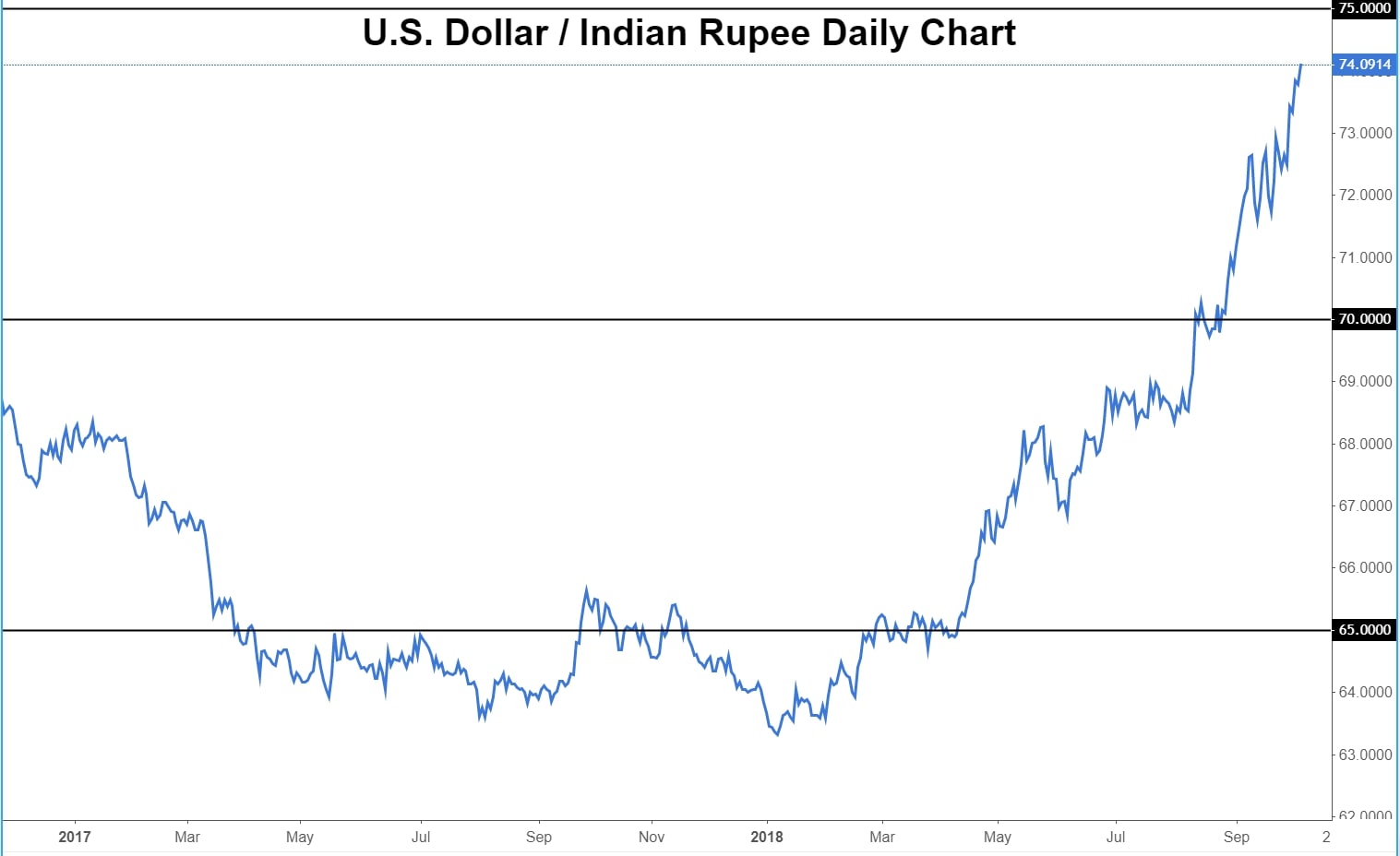
Image

Helping to fuel the latest fall for the rupee was a surprise move by the RBI, which had been widely expected to raise the benchmark interest rate on Friday. Instead, the central bank surprised to the dovish side by opting to keep rates unchanged, which led Indian financial markets, including equities and the rupee, to plunge further. The RBI's lack of action to defend its currency and fend off rising inflation was a shock that the rupee did not need, after already having lost nearly 15% of its value, year to date. The rupee's bleeding will almost certainly slow at some point, but if central bank inaction continues to rule the day, India's currency could have significantly further to fall.

By Caleb Silver, Editor in Chief (The Market Sum, Investopedia.com)

Wednesday, March 26, 2014

Is it a good time to buy IT stocks? – a guest post

Restrictions on gold imports, lower capital goods imports due to a slowing economy and strong FII inflows have contributed to a strengthening Rupee and a lower Current Account Deficit. While that may be good for the Indian economy, it may not be so great for exporters.

Most Indian IT companies generate a significant amount of revenues from exports. A depreciating Rupee had helped companies to increase profits. But a strengthening Rupee has led to profit booking in IT stocks, which are trading below their recent highs.

In this month’s guest post, Nishit makes a strong case for using the corrections to enter IT stocks now. What do you think? Do you feel IT stocks are too expensive? Good things in life usually are.

------------------------------------------------------------------------------------------------------------------------------------------

IT stocks have corrected from their recent highs. The corrections range from at least 10% from the tops in case of TCS and HCL Tech and 15% in case of Infosys. So, is it a good time to buy IT stocks? Let us try and examine the pros and cons.

Why have the IT stocks corrected? The rupee has strengthened 5-6% since January 2014 due to lower gold imports and FII inflows in the hope of a Narendra Modi led Government being sworn in. A strengthening rupee hits the profit margins of all exporters, including IT companies.

The upside to the profits is capped for the time being because of rupee appreciation. Also, IT stocks have run up in the past 1 year. TCS itself has gone up 70-80% from its lows and Infosys has doubled from its lows.

TCS recently had a con-call where it expects 2015 to be a stronger year than the current year. Overall, the IT stocks are dependent on the US and European economies which are slowly recovering back to normalcy. So, the core business of the IT companies which is the main driver for growth is doing just fine.

Now, a strengthening rupee is just an excuse for booking profits. If no strong Government comes at the centre then expect the markets to tank and the rupee to trade in the 66-68 band.

Let us look at the valuations right now. Infosys trades at a P/E of 19 and TCS at 23. None of these stocks are frightfully expensive if one looks at their growth prospects.

If one were to look at Indian IT, I would not look beyond TCS, Infosys and HCL Tech at the moment. These 3 stocks capture the essence of Indian IT.

What happens if Narendra Modi wins? The rupee may appreciate further but the Government would not let it appreciate beyond a point as exports would get hit.

TCS and other IT stocks would act as a hedge for the portfolio as also an investment option. With a 3 year horizon, they look a pretty solid bet.

IT stocks are not dependent on Government policies, have operating margins of 25-30%, have strong brand names. They cancel out most of the negatives which hang over the Indian markets right now.

There are many players listed on the stock market in IT but Infosys, TCS and HCL Tech represent the best bets. TCS from sheer size and scale, HCL Tech for its strength in the Infrastructure management space, and Infosys with the wild card of Narayanmurthy cleaning up the house.

------------------------------------------------------------------------------------------------------------------------------------------

(Nishit Vadhavkar is a Quality Manager working at an IT MNC. Deciphering economics, equity markets and piercing the jargon to make it understandable to all is his passion. "We work hard for our money, our money should work even harder for us" is his motto.

Nishit blogs at Money Manthan.)

Thursday, December 26, 2013

Has gold lost its lustre? – a guest post

We Indians tend to be conservative as far as investments are concerned. Why is that? Perhaps because several generations of Indians have faced hardship and deprivation due to exploitation by our ‘rulers’ – both overseas and Indian. Lack of education and infrastructure have contributed to the tendency to ‘hoard’ rather than ‘invest’.

For generations, two of the avenues for investing our little savings have been in land and gold ornaments. This is true even today in the hinterland – where infrastructure and banking services remain primitive or non-existent.

In larger towns and cities, infrastructure and services have improved to the extent that other avenues of investment – like post office and bank fixed deposits, mutual funds and equity are readily available. But our fascination for investing in real estate and gold has not dimmed.

In this month’s guest post, Nishit suggests that it may be time to reduce investment in gold. Debt and equity investments are likely to provide better returns in the foreseeable future.

-----------------------------------------------------------------------------------------------------------------------------------------

Indians are obsessed with Gold. The most common question which I am always asked is: “Should we buy Gold now or should we wait?” The Government has increased the price of Gold in India by increasing import duty - thereby reducing Gold imports and positively impacting the Current Account Deficit.

Gold by itself has no value in terms of utility and returns. Its status as a safe haven in times of uncertainty lends value to it. Gold’s price rises when uncertainty increases in the world. Earlier, the US dollar was linked to Gold’s price, but after it was delinked and the printing presses took over, the US dollar weakened. More dollars were required to buy the same amount of Gold.

Gold’s price had seen a parabolic rise in the past few years on the basis of fears of a worldwide economic collapse led by the US. Quantitative easing, the flooding of the markets with additionally printed dollars led to Gold’s price spurting up. It finally touched a peak of US $1920 in September 2011.

Gold’s price has been on a steady decline since then and has corrected to about US $1200 from $1920 - a decline of about 37.5% from its peak value. It had risen from a low of US $264 hit in 2001-2002 to $1920. The great Gold bull run may be over for now.

clip_image002

There are various reasons for this prognosis and they are:

  1. The World economy seems to be recovering and the immediate crisis seems to over
  2. US is reducing Quantitative easing; the easy money was one of the main reasons for Gold’s price to sky rocket

When Gold’s price hit a peak of $1920, the Rupee was at 46. Now, when Gold’s price has corrected 37.5% in Dollar terms, the Rupee has depreciated about 35%. Hence, in Rupee terms - thanks also to Government duties – Gold’s price has remained almost stagnant. The future movement in Gold’s price can come due to the Rupee weakening further, leading to appreciation in Gold’s price. The Rupee has been stable for the past few months.

Conclusion:

The value of Gold investing as a portfolio choice is no longer as significant as it was say about a couple of years back. Gold should still occupy maybe 5% of your portfolio instead of the earlier 10-20%. Thanks to the weakening rupee, there is still a chance to exit Gold at a very small loss or profit. Better options can be seen in debt or equity currently.

-----------------------------------------------------------------------------------------------------------------------------------------

(Nishit Vadhavkar is a Quality Manager working at an IT MNC. Deciphering economics, equity markets and piercing the jargon to make it understandable to all is his passion. "We work hard for our money, our money should work even harder for us" is his motto.

Nishit blogs at Money Manthan.)

Related Post

Gold and Silver charts: an update

Wednesday, July 24, 2013

RBI’s liquidity squeezing – a guest post

Vote-bank politics with schemes like NREGA, food securities bill, and hugely hiking the pay of government employees – not to speak of fertiliser subsidy, oil subsidy – has led to a bloated fiscal deficit in India.

Slowdown in global economies – including in India – and rising oil prices have added to the Current Account deficit. Instead of taking pro-active steps to curtail the twin deficits and put GDP growth back on track, the government tried to coerce RBI into reducing monetary controls to re-energise growth.

Instead of succumbing to pressure, the RBI Governor stuck to his hawkish stance against inflation. He is paying the price by not getting an extension of his term in office. His latest step to stem the fall in value of the Rupee by tightening liquidity has not been well-received by the stock market.

In this month’s guest post, Nishit discusses the likely effect of RBI’s action on Gilt Fund yields.

----------------------------------------------------------------------------------------------------------------------------------

Recently, the RBI indirectly raised Interest Rates by squeezing liquidity to curb the pressure on the Rupee. This led to a spike in bond yields from 7.5% to 8.1%. Many of the debt funds lost 3-4% of their NAVs. Many must have panicked, as this had never happened before and can almost be called a ‘Black Swan’ event.

So what does it mean for Gilt funds going ahead? The basic objective of Gilt funds is that they are meant for long term investors when the interest rates are coming down, to capitalize on the increase in Bond Prices when yields come down. One is supposed to exit when the trend has changed and the bond yields are going up.

Was RBI’s intervention a signal that Interest Rates may be going up? I do not think so. The economy is in shambles and to simulate the economy, rates have to come down. RBI’s action was just a one-off blip as a desperate government tried to stop the Rupee from devaluing further.

Bond Yields, which had spiked to 8.1% towards the end of the week, came down to 7.9%. If there are no more unpleasant surprises, then the yields could touch the record low of 7.1% by December. The spike in yield was a buying opportunity for the long term investor.

clip_image002

The very fact that the yield rose from 7.56% to 8.10% and back to 7.94% means that the market had over-reacted and yields are coming down.

The RBI policy on the 30th of July ‘13 will give further guidance on what the RBI intends to do. As I see it, they will maintain a status quo and will neither raise nor cut Interest Rates.

In real terms, home loan rates will not come down. The Auto or the Realty sectors’ hopes of a stimulus will have to keep waiting.

Long-term investors do not need to worry. Only short-term traders, and Banks who conduct treasury operations, will take a hit. Till the economy turns around, I do not see Interest rates rising.

----------------------------------------------------------------------------------------------------------------------------------

(Nishit Vadhavkar is a Quality Manager working at an IT MNC. Deciphering economics, equity markets and piercing the jargon to make it understandable to all is his passion. "We work hard for our money, our money should work even harder for us" is his motto.

Nishit blogs at Money Manthan.)

Wednesday, December 12, 2012

Is this a good time to invest in gold? – a guest post

After a decent rally from the low touched in Jun ‘12, Sensex seems to be stuck in a range – neither moving up much, nor falling down. Retail participation has been low. Those who missed the rally may be waiting for a deep correction to get in. Others are probably waiting to jump in once the index hits 20000.

In this month’s guest post, Nishit argues in favour of gold as an investment avenue because the domestic and global economy is in doldrums.

----------------------------------------------------------------------------------------------------------------------------------------

Gold in Rupee terms has given just about 5-6% return in the past year. Now is a good time to look at the future prospects of Gold as an investment.

The Gold we buy in India is dependent mainly on two factors: the price of Gold in US Dollars, and the exchange rate of Indian Rupee vs. US Dollar. It is a big myth that price of Gold goes up during the Indian wedding season. Even though India is a large consumer of gold, there are other global factors driving the price of Gold.

What has been happening in 2012 is that the price of Gold in US$ and Indian Rupee have been going in opposite directions. When Rupee weakened to the 56-58 range, the price of Gold fell in Dollar terms. Also, when price of Gold rose in US$, the Rupee also strengthened.

Fundamentally, Gold is treated as a safe haven. Whenever there is a global crisis or if economies go bankrupt, the attraction of Gold goes up. 2012 was a relatively stable year and hence the price of Gold is stuck in a range between US$ 1550-1800 per ounce.

The US fiscal cliff and Eurozone sovereign defaults - if and when they happen – will cause the price of Gold to rise. Another benchmark for gold is how many barrels of oil can be purchased by 1 ounce of Gold. Currently it is about 16 barrels, which is the long-term average. If oil’s price begins to rise, gold’s price will also rise.

The exchange rate of Indian Rupee is dependent on foreign inflows. Once the inflow dries up, the price of gold will start going up in Rupee terms.

So, the price of Gold for Indians is dependent on:

  1. Rupee (watch the FII inflows)
  2. Price in US$ (watch related commodities like crude oil, and foreign economies)
  3. Performance of Dow Jones and other foreign indices

Also, just to slip in a bit of technicals, US$ 1800 has been a resistance level for more than a year and hence, expect a rally when gold’s price closes above 1800 for 3-4 days.

For the price of Gold to rise in the current scenario, the global economy has to either weaken or boom dramatically for speculation to take place. A boom seems unlikely and hence the most likely scenario is the Western economies slipping down into recession again.

One should be invested in Gold to the extent of 10-15% of one’s portfolio. It acts as a hedge against inflation simply because it guards against Rupee weakening. Once upon a time, when Rupee was strengthening and the exchange rate was heading towards Rs.40 to US$ 1, it did not make sense to add Gold.

If the Indian economy does as badly as in late 2011, it may be sensible to add Gold. In a nutshell, whenever any economy is doing badly, either domestic or global, it is a good time to invest in Gold. Even in 2008, Gold’s price shot up after the equity markets tanked.

----------------------------------------------------------------------------------------------------------------------------------------

(Nishit Vadhavkar is a Quality Manager working at an IT MNC. Deciphering economics, equity markets and piercing the jargon to make it understandable to all is his passion. "We work hard for our money, our money should work even harder for us" is his motto.

Nishit blogs at Money Manthan).

Tuesday, July 28, 2009

Are the stock and currency markets interdependent?

The BSE Sensex index continues to move in a sideways consolidation range between 13500 and 15600, apparently unaffected by the RBI's recent policy announcement of keeping interest rates unchanged.

A prolonged period of sideways movement puts investors in a quandary. Those who missed the rally are itching to get in. Those who were smart enough to invest at lower levels are sitting on big profits, but worried about a crash around the corner.

This is a good time to do nothing - as far as transacting in the stock market is concerned. Use the lull period to do research on individual stocks and brush up on the fundamentals of money supply and how they affect different markets.

The short answer to the question is: Yes, both markets are interdependent locally and globally. The long answer follows.

There is little direct relationship - most of it is through indirect effects of money flows, global businesses, inflation rates and interest rates. It may not be out of place to mention here that the forex market is massive, about $1.5 Trillion per day - a week's trading is equivalent to twice the annual turnover of the New York stock exchange! Interested readers may want to read this article.

Think about the Dow, which had a strong rally last week. Investors from outside the USA, whose domestic markets may not be performing so well - France, for instance - may decide that it is time to enter the US market.

They convert a sackful of euros into US dollars. Depending on the size of the sack, the euro will go down in value relative to the US dollar. May be currency traders figure out that some thing is going on and start to buy US dollars and sell euros.

Investors in Germany decide to join the party. More euros are sold to buy dollars to invest in the US market. With foreign investors pumping in money, both the dollar and the Dow start to rise, as the euro drops.

The opposite happens if the Dow tanks. Foreign investors pull out of US stocks, convert dollars to euros that makes the euro appreciate and the dollar depreciate. The logical conclusion should be that the level of a stock index is directly proportional to the value of the underlying currency.

But it is more complicated than that. Let us take the example of CocaCola. It now sells more outside the US than within the US. For argument's sake, let us assume that the bulk of its sales are from the euro countries. If the dollar tanks and euro appreciates, CocaCola's US sales and profits may suffer but their higher euro-zone profits will more than cover the gap.

CocaCola may declare better Q2 profits, as may IBM and Microsoft and others if they sell more in the euro-zone. End result? The Dow may shoot up if the index components make super profits, while the dollar tanks.

With FIIs pumping in money, the BSE Sensex index nearly doubled from its Mar '09 lows. Logically, the Rupee should have gained against the US dollar. But it is at a lower level now than a year back.

I have a couple of questions for readers:

Why do you think the Rupee depreciated when the Sensex went up?

Why do you think the RBI left interest rates unchanged?

(Thanks to reader Rajeev, for suggesting that I write something about the interdependencies of the different markets. This post is already too long. I plan to write about the bond market and commodities market in future posts.)

Related Posts

How you can stay ahead by being interested in interest
What the CRR-SLR-Repo cuts mean for investors

Monday, March 16, 2009

Stock Market News, Financial News - Mar 16, 2009

Bharti to recast business in April '09

NEW DELHI (Reuters) - Bharti Airtel Ltd, India's top mobile operator, will restructure its businesses next month as it looks to expand beyond voice telephony, the Economic Times reported on Monday.

The newspaper said Bharti would expand its three divisions to nine to focus on mobile commerce, Internet, enterprise business and small and medium business.  (More ...)

-----------------------------------------------------------------------------------

iGate says Satyam bid below current market price

MUMBAI (Reuters) - U.S.-based iGate Corp's bid for fraud-hit Satyam Computer Services will be well short of the current market price, its chief executive told a television channel on Monday.

"I mean what we have picked up in terms of the financial, I do believe our bid will be quite a bit south of the 90 cents a share, which is currently the market price of Satyam," Phaneesh Murthy said on CNBC-TV18.  (More ...)

---------------------------------------------------------------------------------

Rupee off 2-week high as importers buy dollars

MUMBAI (Reuters) - The rupee retreated after climbing to its strongest in more than two weeks early on Monday, as importers bought the U.S. dollar but gains in regional currencies and local shares should support.

At 10:20 a.m., the partially convertible rupee was at 51.60/62 per dollar, after touching 51.33, its highest since Feb. 27. It had closed at 51.48/50 on Friday.  (More ...)

----------------------------------------------------------------------------------

US recovery to begin in 2010: Bernanke

Federal Reserve Chairman Ben Bernanke suggested in a taped interview on Sunday that the US recession could last most of the year and said the biggest risk was that the political will needed to fix the fractured financial system could be lacking.

"This (economic) decline will begin to moderate and we'll begin to see a leveling off," Bernanke said when pressed during an interview on the CBS program "60 Minutes" about whether he sees the recession ending this year.  (More ...)